Genesis 14:18-20 | Psalm 110:1-4 | 1 Corinthians 11:23-26 | Luke 9:11 b–17
Give them some food yourselves (Luke 9:13)
Brothers and sisters in Christ,
Today, the Church invites us to kneel in awe and gratitude before one of the greatest mysteries of our faith: the Most Holy Body and Blood of Christ, the Eucharist. This is not simply a feast. It is the heart of who we are as Catholics, the living memorial of Jesus’ self-giving love, and the daily bread that sustains us on the journey of life.
I. The Meal that Gives Meaning
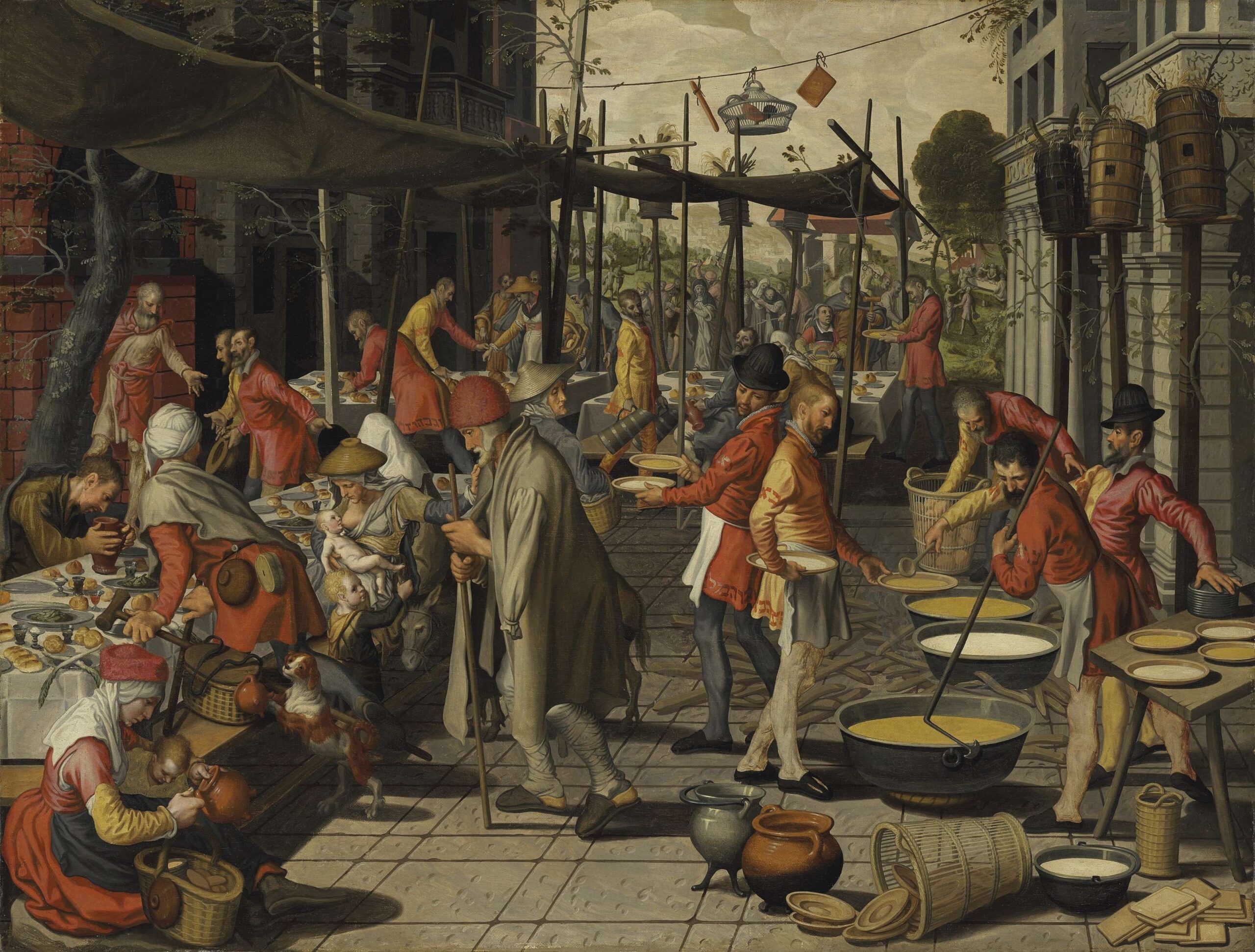
In today’s Gospel, we hear of Jesus feeding the multitude with five loaves and two fish. At first glance, it seems like a miracle of quantity—taking a little and making it much. But this is more than a story of multiplication; it is a sign pointing us toward the Eucharist. Notice what Jesus does: “He took, blessed, broke, and gave.” (Luke 9:16)
These four verbs—took, blessed, broke, gave—are the same actions He performs at the Last Supper and every time we celebrate Mass. They are the language of the Eucharist. In every Mass, Jesus takes our humble offerings, blesses them, breaks them open in sacrificial love, and gives them back to us as Himself.
The miracle in Luke’s Gospel is about more than feeding empty stomachs; it’s about revealing the deep hunger of the human heart—for communion, for belonging, for meaning—and how only Christ can satisfy that hunger.
II. Melchizedek and the Eternal Priesthood
Our first reading introduces a mysterious figure: Melchizedek, king of Salem and priest of the Most High God, who brings out bread and wine and blesses Abram. Why is Melchizedek important? Because he foreshadows Christ. Psalm 110 proclaims, “You are a priest forever in the line of Melchizedek,” and this verse is applied directly to Jesus in the Letter to the Hebrews (Heb 5:6).
Unlike the Levitical priests of Israel, whose sacrifices were repeated and temporary, Melchizedek’s priesthood was eternal and universal—and so is Christ’s. When Jesus instituted the Eucharist at the Last Supper, He was not simply giving a symbol. He is offering the once-and-for-all sacrifice of Himself, under the signs of bread and wine, through the eternal priesthood. The bread and wine of Melchizedek are no longer a shadow. In Christ, they become His very Body and Blood.
III. “Do This in Memory of Me”—A Living Memorial
Saint Paul’s words in 1 Corinthians are the oldest written account of the Last Supper, predating even the Gospels. He passes on what he received: “This is my body… This cup is the new covenant in my blood… Do this in memory of me.” (1 Cor 11:24 25). We often think of memory as something like a mental remembering of a birthday or a lesson from school. But in Jewish tradition, to “remember” is something much more profound. The Greek word Paul uses—anamnesis—means to make present a past reality. Every time we celebrate the Eucharist, we are not merely recalling the Last Supper; we are entering into it. Christ’s one sacrifice on the cross is made present to us again, not in a bloody way, but in a sacramental and real way.
When Jesus says, “Do this in memory of me,” He is commanding us to participate in His life-giving act of love—and to let it transform us.
IV. A Crisis of Belief in the Real Presence
But here, we must pause. As we contemplate the Real Presence of Jesus in the Eucharist, we are confronted with a sobering reality: so many Christians-yes, even many Catholics no longer believe that Jesus is truly present, Body, Blood, Soul, and Divinity, in the consecrated host.
A 2019 Pew Research study found that only about 31% of U.S. Catholics believe in the Real Presence—that the Eucharist is truly Jesus Christ. The majority think it is only a symbol. Even among those who attend Mass regularly, significant confusion and doubt remain.
How did we get here? Perhaps it’s the result of poor catechesis, the routine of repetition without reflection, or a loss of reverence in our approach to the altar. In some instances, it may arise from our modern mindset, which struggles to accept mystery—that is, our desire to explain everything in physical, observable terms. But Christ was clear. In John 6, He says, “My flesh is true food and my blood is true drink” (John 6:55). When many of His followers departed because of this “hard saying,” Jesus did not soften His words. He allowed them to go. He meant what He said.
We must believe because Jesus said it. We must believe because He gave Himself for us in this sacrament, as the eternal Lamb who takes away the sins of the world. The same Jesus who walked the roads of Galilee now comes under the appearance of bread and wine—not to be admired from a distance, but to be consumed in love.
V. A Story of the Real Presence
Allow me to share with you a story from 13th-century Italy, which played a key role in the establishment of this very feast. A German priest, Fr. Peter of Prague, was struggling with doubt about whether Christ was truly present in the Eucharist. While celebrating Mass in the town of Bolsena, as he spoke the words of consecration, the host began to bleed onto the corporal and altar cloth.
Terrified and awestruck, he stopped the Mass. The miracle was reported to Pope Urban IV, who was nearby in Orvieto. The pope declared it a true Eucharistic miracle and instituted the Feast of Corpus Christi in 1264.
What Fr. Peter experienced in that miracle, we are invited to experience with the eyes of faith every time we approach the altar. The real presence of Jesus in the Eucharist is not a metaphor. It is a mystery— a mystery grounded in love. A love that goes to the Cross. A love that wants to remain with us, not just in memory, but in presence.
VI. For Today’s World: Becoming What We Receive
And what does all this mean for us today?
It means that the Eucharist is not just a ritual—it is a revolution of love. In a world starving for meaning, justice, peace, and healing, Jesus says to His disciples—and us—“Give them some food yourselves.” (Luke 9:13)
The Body of Christ we receive is meant to make us the Body of Christ for the world. As St. Augustine once preached, “If you are the body and members of Christ, it is your mystery that is placed on the Lord’s table… Be what you see, and receive what you are.”
This means we are called to be Eucharist to others—to be broken and given in love. To feed the hungry, comfort the sorrowful, forgive those who wound us, and be instruments of peace in our families and communities. In a culture often marked by isolation, division, and consumerism, the Eucharist calls us to communion, sacrifice, and self-gift.
VII. The Procession: Proclaiming Jesus to the World
And today, as part of our celebration, we will take this presence of Christ in the Monstrance into the streets in a Eucharistic procession. We do not hide our King. We adore Him publicly. We praise Him in our neighbourhoods, because the Lord who feeds us within these walls is also the Lord of our communities, our schools, our workplaces, our homes.
As we walk with Jesus today, we declare with our steps what we believe with our hearts: that Jesus is truly present in the Eucharist, and that He desires to bless not only us, but our entire town and our entire world.
VIII. The Table that Unites Heaven and Earth
Finally, brothers and sisters, the Eucharist is a foretaste of the heavenly kingdom. At every Mass, heaven touches earth. The saints and angels are with us. The living and the dead are united in the eternal banquet of the Lamb. When we come to the altar with faith, we are not just attending an event; we are stepping into eternity.
And so, as we come forward today to receive the Body and Blood of Christ, let us do so with reverence, hunger, and love. Let us allow this sacrament to renew our hearts, transform our lives, and send us forth as bread for the world.
Let us remember:
• In Melchizedek, we see the eternal priesthood of Christ.
• In the Last Supper, we receive a love that makes itself present every day.
• In the multiplication of loaves, we see our mission: to take, bless, break, and give ourselves to others.
• In the Eucharist, we find Jesus—not as a symbol, but as food for the journey, presence for the lonely, healing for the broken, and hope for the world.
• And in our procession today, we proclaim to all who see us: Jesus is here. He is with us. He is alive.
“This is my body… this is my blood.” May we receive Him today with hearts wide open—and become what we receive. Amen.